The Sound Map of a Familiar Room
A sound map of a familiar room turns background noise into a readable inventory, helping you notice what belongs, what changes, and where each sound comes from.
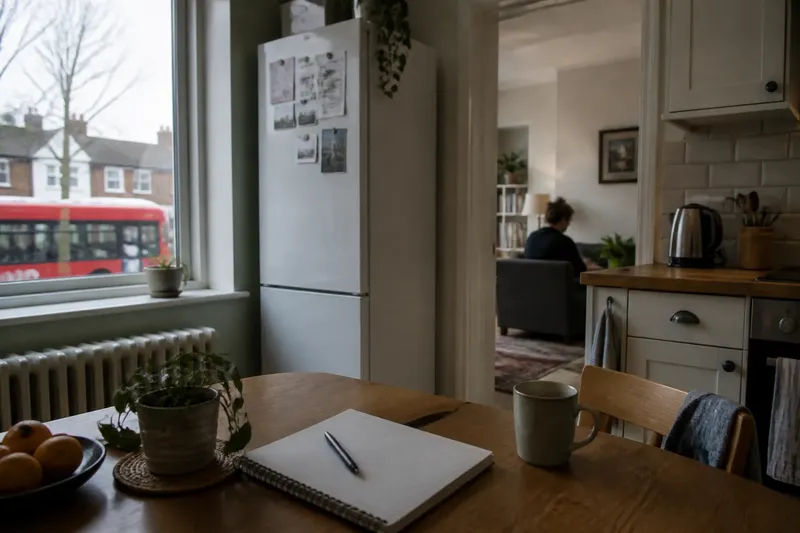
The refrigerator clicks off, a bus sighs at the curb, and a radiator gives the small metallic answer it always gives. A sound map of a familiar room begins with those ordinary noises, not with an effort to make the room quiet. Naming what is already there can make the space feel more legible: its edges, connections, and changing activity become easier to notice.
This is a listening inventory, not a concentration exercise. You do not need to identify every sound or decide whether it is good or bad. The useful question is simply: what is audible, where does it seem to come from, and how does it behave?
1. Choose a room and a listening position
Pick a room you use often, such as a kitchen, bedroom, or living room. Sit or stand where you normally would. A familiar position gives the inventory a clear starting point, and there is no need to close your eyes or change the room’s usual arrangement.
Let the room continue as it is. A kettle may be heating, a laptop fan may be running, or someone may be moving in another part of the home. The point is not to create a special listening condition; it is to attend to the setting you actually inhabit.
For a simple record, use a scrap of paper or a notes app. Leave space to add a sound’s location and pattern later. If writing feels like another task, keep the inventory in mind and make only a few notes afterward.
2. List sounds before you interpret them
Begin with a plain inventory. Write “low hum,” “two sharp taps,” or “voices beyond the wall,” rather than deciding at once that a sound is annoying, comforting, or important. Description keeps the first pass open; interpretation can come later if it proves useful.
Notice sounds that continue and sounds that arrive briefly. A vent may produce a steady breath of air, while a cupboard door gives a short thud. A clock may be easy to miss until attention settles on its regular tick.
Leave uncertain sounds as uncertain. “Soft rattling near the window” is a perfectly serviceable entry. You are making a map of perception, not conducting an investigation, and a guessed source can be more distracting than a careful description.
- Continuous sounds: hums, airflow, traffic wash, or an appliance running.
- Repeated sounds: ticking, a fan turning, footsteps along a familiar route.
- Brief sounds: a latch, a passing vehicle, a pipe’s short knock.
- Human sounds: conversation, a cough, movement in a nearby room.
3. Give each sound a place in the room
Next, note where a sound seems to come from. Use simple terms such as “near,” “behind,” “above,” or “outside the left window.” The location does not need to be exact. Even a rough distinction between a sound inside the room and one beyond it can clarify how the space connects to its surroundings.
Some sounds seem to sit close to the listener: a desk fan or a phone vibrating on a table. Others arrive from farther away, softened by a hallway, a closed door, or the building exterior. That difference gives the room depth, much as a floor plan gives walls and doorways a place.
Imagine you are sitting at a kitchen table and hear a low, steady hum near the counter, with occasional tire noise beyond the window. You note the hum as “inside, near the appliances” and the tire noise as “outside, passing.” The result is not a diagnosis of either sound; it is a clearer sketch of how the kitchen opens onto the rest of the home and street.
4. Notice the shape and rhythm of each sound
A sound’s pattern can be as informative as its source. Does it stay level, pulse, repeat, fade, or arrive in irregular bursts? “A short rattle when the fan turns” contains more useful detail than “noise,” while still avoiding a claim about what caused it.
Listen for changes in texture, too. A motor may grow rougher and then smooth out; distant traffic may swell as vehicles approach and recede. You need not track every occurrence. One clear observation is enough to distinguish a steady background layer from an event that comes and goes.
Timing can help separate overlapping sounds. The refrigerator’s low hum might continue beneath a brief click, while footsteps appear only when someone crosses the hall. Treating them as separate entries makes the inventory easier to read than placing every sound under a general label such as “house noise.”
5. Add the room’s boundaries and connections
A sound map can include what a sound seems to pass through. Mark whether it is heard directly, softened by a door, or blurred by distance. A muffled voice from a hallway tells you something different from a voice in the same room, even if the words are not clear.
Notice the openings that make the room acoustically connected: a window facing a street, a doorway beside a busy corridor, or a vent that carries sound from elsewhere in the building. These are not defects to fix. They are part of the room’s everyday geography, much like a doorway you use without consciously registering it.
Materials can change how a sound reaches you. Curtains and upholstered furniture may make some sounds seem less sharp; a bare counter or hard floor may make a brief tap more noticeable. Record what you hear rather than assuming a particular material must be responsible.
6. Compare a familiar sound with its usual pattern
Once the inventory feels recognizable, notice what counts as ordinary for that room. A familiar sound does not need to be pleasant or perfectly consistent. It may simply be one that tends to belong to the room at particular times, such as a neighbor’s footsteps in the hallway or a heating system cycling on.
Compare only with your own sense of the room, not an imagined ideal of how it ought to sound. A sound that appears new may turn out to be an old one you had stopped noticing. Conversely, a familiar source may have changed its timing or quality. The map gives you words for that distinction without forcing a conclusion.
If a sound is concerning, disruptive, or seems connected to a practical problem, ordinary listening is not a substitute for checking the relevant appliance guidance or asking an appropriate professional. For routine noticing, though, it is enough to record the sound as unfamiliar and leave the cause open.
7. Use the inventory to make the room easier to read
Look over the notes and ask what the room’s sound pattern reveals about its activity. Perhaps one layer comes from the building, another from the street, and another from people moving through the home. You may notice that quiet in one corner does not mean the whole room is acoustically empty; it may simply be farther from the main sources.
This can be useful when returning to a room after time away or moving between rooms during an ordinary day. A brief inventory gives attention a few recognizable landmarks: the soft fan, the distant traffic, the hollow sound from the hall. The room can feel more understandable because its background is no longer one undifferentiated wash.
There is no requirement to keep a permanent record or repeat the exercise on a schedule. A note made once can be enough; a second listen may be useful if the room’s pattern has noticeably changed. The map is a small description, not a new household duty.
What should a sound map include?
Do I need to identify every sound?
No. Record a few distinct sounds and leave unclear ones with a neutral description. The aim is to distinguish layers and locations, not to account for every click.
Should I listen in silence?
No special silence is needed. Ordinary room activity is the material for the inventory, including voices, appliances, and sounds from outside.
How is a sound map different from a list of noises?
A basic list names sounds; a sound map also notes where they seem to come from and how they behave over time. Those details show how the room relates to its doors, windows, occupants, and surroundings.
What if I cannot tell where a sound comes from?
Write down its apparent direction or quality, such as “distant, behind the wall” or “soft tapping, source unclear.” Uncertainty is part of an honest inventory, not a gap that must be filled.
Keep the map small enough to use
A useful sound map may fit in a handful of lines: a steady hum near the counter, voices beyond the doorway, traffic outside the window, and an occasional click from somewhere in the room. Each entry gives a sound a basic identity, location, and pattern. That is enough to make the familiar room easier to read without asking it to become silent.
The next time the room seems like one broad blur of background noise, choose one sound and give it a place. A sound map of a familiar room is most useful when it leaves you with a clearer sense of what is around you, not a longer list of things to manage.